
Innovation
Automating Personalized Video
AI video automation represents the shift from making videos to operating video experiences.
Author Name
Author Title
Published :
By 2026, video is no longer a marketing tactic—it’s infrastructure. The brands pulling ahead aren’t creating more videos; they’re building systems that generate personalized video automatically, powered by data and artificial intelligence.
This shift toward AI video automation marks a fundamental change in how content is produced, distributed, and experienced. What once required teams, timelines, and budgets now operates continuously in the background—at scale.
From Content Creation to Content Systems
Traditional video production was never built for personalization. Even templated workflows break down when every customer, account, or user journey requires unique messaging.
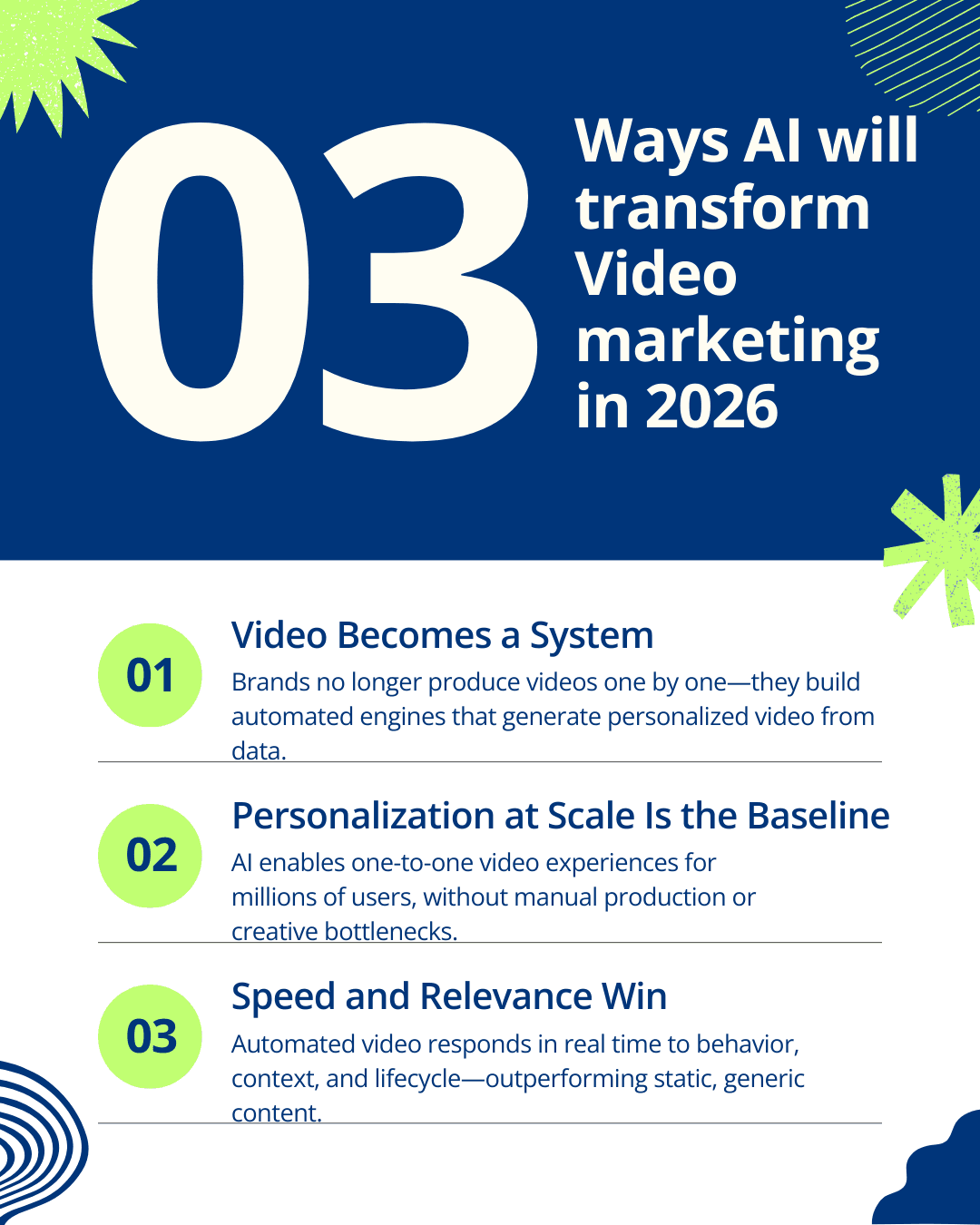
AI video automation flips this model. Instead of creating individual assets, brands design rules, templates, and data connections that allow video to be generated dynamically. The output feels personal, but the process is fully automated.
In 2026, leading organizations no longer ask, “How many videos should we make?”
They ask, “What data should power our video experiences?”
What Is AI Video Automation?
AI video automation is the use of artificial intelligence to create, customize, and deploy video content automatically—often in real time—based on structured inputs such as:
Customer or user data
Behavioral signals
Product usage
Lifecycle stage
Geographic or contextual variables
These systems remove manual production from the loop, enabling one-to-one video experiences at one-to-many scale.
Why AI Video Automation Has Become Essential
Personalization Has Become a Baseline
Audiences now expect relevance by default. Generic video is easy to spot—and easy to ignore. Automated personalization allows messaging to adapt continuously without human intervention.
Speed Outperforms Perfection
In fast-moving markets, the most effective video is often the most timely. AI video automation enables instant responses to user behavior, product changes, or market conditions.
Scale Without Creative Bottlenecks
Manual workflows scale linearly: more output requires more people. Automated video systems scale exponentially, with minimal incremental cost.
Data Becomes the Creative Driver
In automated video, storytelling is guided by data rather than intuition alone. This results in messaging that is more precise, contextual, and measurable.
Where Brands Are Using AI Video Automation in 2026
AI-powered video systems now span the full customer lifecycle:
Marketing: Personalized ads, landing page videos, and email embeds
Sales: Account-specific explainers and proposal walkthroughs
Onboarding: Automated welcome and setup videos triggered by user actions
Customer Success: Usage-based education and milestone updates
Retention: Personalized renewals, summaries, and re-engagement content
Video is no longer static—it’s responsive.
The Technology Enabling the Shift
Several breakthroughs have accelerated adoption:
AI-driven speech and lip synchronization that supports natural personalization at scale
Deeper data integrations connecting CRMs, analytics, and product platforms directly to video generation
Cloud-based rendering and delivery, removing traditional production constraints
Together, these advances make automated video practical, reliable, and cost-effective.
AI Video Automation vs. Traditional Video Models
Traditional Video | AI Video Automation |
Static assets | Dynamic, data-driven output |
Manual editing | Automated generation |
Long production cycles | Near-instant creation |
High cost per video | Minimal marginal cost |
This isn’t an efficiency upgrade—it’s a structural change.
What This Means for the Next Generation of Brands
In 2026, competitive advantage doesn’t come from better video—it comes from better systems. Brands that treat video as infrastructure can personalize at scale, respond in real time, and continuously optimize messaging.
Those that rely solely on manual production will increasingly struggle to keep pace—not because their content lacks quality, but because it lacks adaptability.
AI video automation represents the shift from making videos to operating video experiences.
And that shift is redefining how brands communicate.
Related Reads for You
Discover more articles that align with your interests and keep exploring.